

Why You Need Systems in Your Life, According to Neuroscience
Because your brain was never meant to decide this much
Why you need systems in your life becomes obvious when you notice how tired you feel before the day is even halfway done.
Not physically tired.
Mentally worn.
Emotionally stretched thin by choices that didn’t feel like choices at all.
What to eat.
When to start.
When to stop.
What deserves your attention?
What can wait?
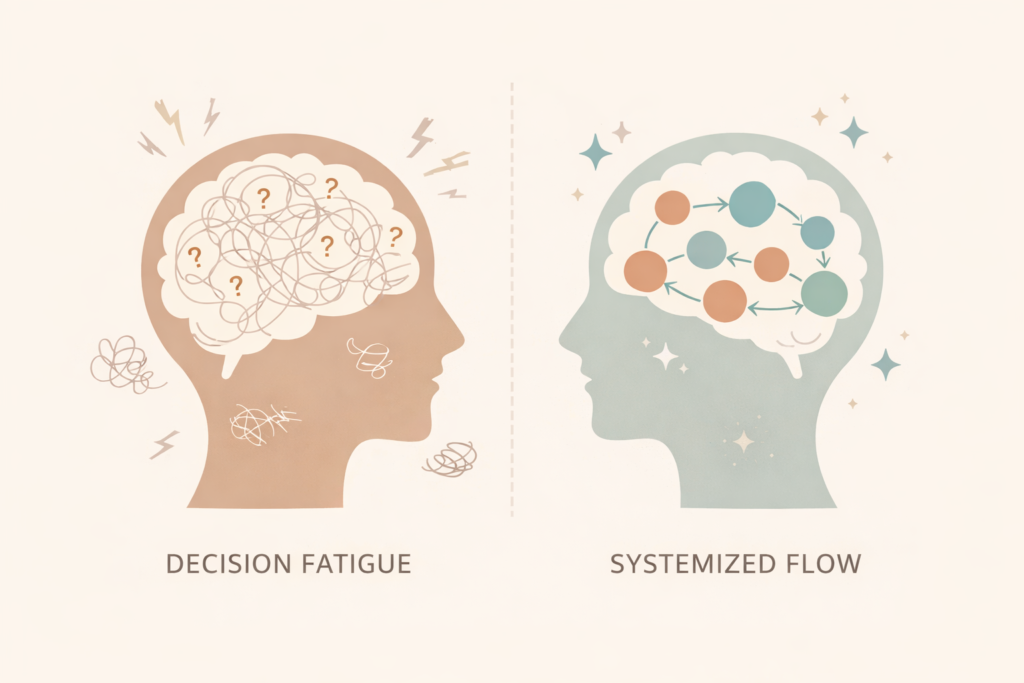
Your brain has been quietly working nonstop, and neuroscience tells us this constant decision-making comes at a cost.
Your Brain Is an Energy-Saving Organ, Not a Productivity Machine
The human brain is designed to conserve energy. From a neurological perspective, its primary job is not optimization or achievement—it’s survival.
Every conscious decision activates the prefrontal cortex, the part of the brain responsible for planning, reasoning, and self-control. While powerful, this area fatigues quickly.
When decisions pile up, the brain doesn’t rise to the challenge. Instead, it looks for relief.
It defaults to:
- habits
- shortcuts
- emotional choices
- environmental cues
This is not a failure of discipline. It’s biology.
And this is exactly why systems matter.
The 200 Daily Food Decisions That Reveal How Little We Notice
One of the most revealing neuroscience-adjacent findings comes from research on eating behavior.
Studies show that humans make over 200 food-related decisions per day, yet most people believe they make fewer than 20. These decisions include when to eat, how much to serve, whether to continue, and when to stop—many of which happen without conscious awareness.
Even more striking, participants consistently denied being influenced by environmental factors like plate size, bowl size, or food visibility—despite eating significantly more when those factors changed.
The takeaway is simple, but profound:
Most of our daily decisions are not deliberate. They are automatic responses to systems around us.
Systems already shape your life. The only question is whether they are intentional.
Systems Are Not About Control — They’re About Relief
Many people resist systems because they fear rigidity. However, neuroscience suggests the opposite effect.
When your brain doesn’t have to decide, it relaxes.
Systems reduce:
- decision fatigue
- emotional reactivity
- cognitive overload
They create a sense of steadiness—something the nervous system deeply craves.
A system doesn’t tell you what to feel.
It tells your brain, “You’re safe. This is handled.”
That reassurance alone frees up enormous mental space.
Why Less Choice Often Creates More Freedom
Modern culture praises endless choice. Yet neurologically, too many options exhaust us.
When trivial decisions disappear, your brain can redirect energy toward:
- creativity
- presence
- deeper thinking
- meaningful connection
This is why many artists, writers, and thoughtful workers rely on simple routines. Not because they lack spontaneity—but because they protect their inner world.
Freedom is not having infinite options.
Freedom is not having to negotiate with yourself all day long.
Systems Regulate Your Nervous System, Too
Beyond cognition, systems have a powerful emotional impact.
Predictability signals safety to the nervous system. When your days contain gentle structure, your body stays out of constant alert mode.
This often shows up as:
- less background anxiety
- fewer guilt-driven thoughts
- more ease when resting
- greater emotional resilience
Systems act like a soft framework that holds you when life feels loud.
Gentle Systems That Actually Work With Your Brain
You don’t need complex planners or rigid schedules. In fact, simpler systems tend to last longer.
Environmental Systems
Your surroundings decide before you do.
- keep healthier foods visible
- reduce friction around supportive habits
- arrange your space to reflect how you want to feel
Just as plate size affects how much we eat, environment shapes how we live.
Rhythm-Based Systems
Repetition calms the brain.
- similar wake and wind-down times
- themed days (admin days, creative days, meeting days, social days)
- transition rituals between work and rest
Rhythm removes internal negotiation.
One-Time Decisions
Decide once, benefit daily.
- rotating meals
- a core wardrobe
- fixed work blocks
Energy saved is energy returned to you.
In a Noisy World, Systems Are Protection
We live in a constant stream of information, notifications, and comparisons. The brain was never designed for this level of input.
Systems create quiet boundaries.
They protect:
- attention
- emotional energy
- long-term intentions
Without systems, urgency wins.
With systems, values stay visible.
How to Begin Without Overhauling Your Life
Start where you feel the most friction.
Ask yourself:
- Where do I feel mentally tired every single day?
- Which decision keeps repeating?
Create one small agreement with yourself.
One structure.
One rhythm.
One gentle boundary.
Let it support you.
Conclusion: Systems Are a Form of Self-Respect
Why you need systems in your life has nothing to do with doing more.
It has everything to do with honoring how your brain actually works.
Neuroscience reminds us that constant deciding leads to exhaustion. Thoughtful systems offer relief, clarity, and steadiness in return.
You don’t need systems because you’re rigid.
You need systems because you’re human.
And choosing ease is not a weakness—it’s wisdom.
Call to Action
If this resonated, explore creating one supportive system this week—or browse our Work Rhythm guides for gentle, brain-friendly structure. Your future self will thank you.








#Comments (2)
The 2026 Bingo Card Goal Setting System That Keeps Me Motivated All Year
[…] And if you’re curious about how systems can simplify your life and actually make it better, read my blog post: “Why You Need Systems in Your Life, According to Neuroscience.” […]
Creatine for Brain Health: Cognitive Benefits, Jet Lag & Focus
[…] If you enjoy exploring ways to support your well-being through simple habits and structure, read Why You Need Systems in Your Life. […]